Tax the Rich, they say.
I’ve been talking to Blue Dogs Coalition co-chairs Jared Golden and Marie Gluesenkamp Perez about how they hope to build the power of rural and working-class Democrats for the past few years. Ahead of the 2024 election, Golden told me he hoped that Democrats would win a slim majority in Congress, giving Blue Dogs outsized power over the agenda.
That didn’t happen in 2024, but some of the candidates endorsed by the Blue Dogs PAC back then — like Rebecca Cooke in WI-03 — went on to win in 2026. Of the more than 40 House seats flipped in this election, 14 were endorsed by the Blue Dogs PAC and include some of the most popular newcomers: Bobby Pulido (TX-15), Sam Forstag (MT-01), Cooke in Wisconsin and Jamie Ager (NC-11). They also include some of the biggest election-week surprises, like Eileen Laubacher, who ousted Lauren Boebert in CO-04 and Zack Mullock who shocked everyone by beating Republican Rep. Jeff Van Drew in NJ-02.
So what does the future hold for this coalition, nearly all of whom represent districts that are full of rural or working-class voters who voted in spades for Trump and Republicans in the past? Some members of the Blue Dogs, including Forstag, Cooke and Pennsylvania’s Bob Brooks, were endorsed by progressive Sen. Bernie Sanders during the midterm election. Brooks and Forstag plan to share caucus time between Blue Dogs and the Congressional Progressive Caucus in January. While many of these members are sometimes more conservative on social issues — a stance reflective of their rural and working-class communities — they often are not particularly moderate on the economy, corporations, or taxes.
So I called up and chased down Blue Dogs — old and new — on the Hill and in Denver last week to ask them about the caucus’ future.
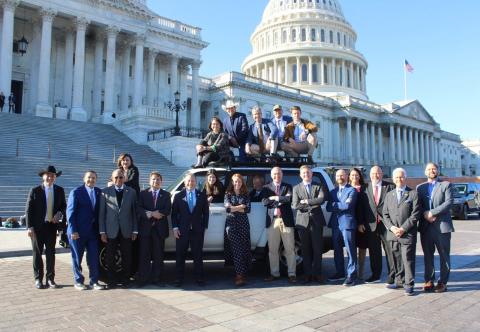
The Blue Dogs Coalition will grow by nearly 150 percent come January, and the rural, working-class populism they’ve always championed is the topic du jour across the country. But exactly how they approach politics and policy seems to be something of a mystery to the largely non-rural and non-working-class D.C. political world. Are they centrist? Are they progressive? Are they moderates? The answer is “yes” — sometimes they’re a bit of each.
“I don’t think either Marie or I think of ourselves as moderates,” Democratic Rep. Jared Golden of Maine told me in April 2024 — calling that label “DC insider politics” and referring to himself and the Washington congresswoman as “different, or outsiders in a lot of different ways.”
Golden and Gluesenkamp Perez (D-Wash.) both flipped red districts in 2018 and 2022, but unlike swingy suburban districts that split their ticket to vote for Trump and a centrist Democrat, Golden and Gluesenkamp Perez represented districts that are heavily rural and working-class. Their districts are more akin to those flipped by a myriad of Democrats on election night this year, where voters do not always align with college-educated liberals on social issues, but at the same time are also often economically populist.
Now the coalition has an expanded number of House members ready to further confuse Capitol Hill through their refusal to slot neatly into one spot on the moderate-to-progressive spectrum. Golden is retiring this year and will be replaced as Blue Dogs PAC chair by California Rep. Adam Gray. But Golden, who was one of the original members to reshape the moderate Blue Dogs Coalition of old into something more rural, working-class and populist, says that despite being a smaller caucus Democrats will have to pay attention to the coalition if they want to keep a large majority for years to come.
“We’re not going to be holding many of these seats if we completely ignore the coalition of voters that got us here,” Golden told me after House votes last week, adding that Democrats should want to retain this majority in 2028 and 2030. “What good is it to get someone in the White House after two years [if] they don’t have a Congress to work with?” he added.
His co-conspirator of four years, Gluesenkamp Perez, made the same argument on a call the next day. (We’ll call her MGP from here.)
“We have people who are, I think, very attuned to what it’s like to try to navigate the economy,” she said, and who understand “the nuance of how government is not working for people who actually work for a living.”
In 2026, there are more than a dozen Blue Dogs who truly are “normal people,” as MGP calls them: Forstag was a smokejumper and union organizer. Ager owns a farm in the North Carolina mountains. Bob Brooks has spent the last 20 years sharing a firehouse bunk room in PA-07, and is excited to live in his own apartment for once. And Rebecca Cooke recently told constituents she’ll continue waitressing until she leaves for Congress in January.
Golden and MGP hope that the Democratic caucus in the House will look to these members — many of whom will be at the front line of maintaining this majority in 2028 and 2030 — to help shape a policy agenda that will keep rural and working-class Republicans and right-leaning independents in the fold.
The surprisingly progressive Blue Dog Caucus?
Blue Dogs are most accurately placed hovering somewhere beside or above the political spectrum, rather than on it. At times, they’re the most conservative voice in the room, and then suddenly, they’re sounding like attendees at an Occupy Wall Street rally:
“It’s recentering power around working people and their ability to run a business,” MGP told me on our call last week, proposing “the kinds of tax reform that mean that working people aren’t carrying all the burden of paying for government,” and “closing all these rich people tax loopholes.”
MGP’s “tax the rich” rhetoric has already made it to the ears of CPC members like Rep. Maxine Dexter, a member of the Congressional Progressive Caucus who represents Portland, Ore. — directly across the Columbia River from MGP’s SW Washington district.
“I think that whether it’s fiscal accountability or taking care of our safety nets and our people, there is some alignment there, which is surprising,” said Dexter, acknowledging that she and MGP vote differently on many issues, but that perhaps people have been placing Blue Dogs in the wrong place on the political spectrum.
“Ultimately they’re [for] labor, jobs, working families, more traditional values,” Dexter said. “That is part of where I think the Democrats lost our way, is we stepped away from that, right? And that’s really coming back to our roots in a lot of ways.”
Congressmen-elect Bob Brooks and Sam Forstag will be members of both the Blue Dogs and the Congressional Progressive Caucus. Brooks said he’s spoken with Blue Dogs PAC Chair Adam Gray about being a bridge between the two groups “because there’s so much in common when we just start looking at people — working-class people. And that’s what I think both of these groups have in mind right now.”
Brooks said Blue Dogs and CPC are aligned on policies including ending the War in Iran and finding ways to get grocery prices down. “They’re both going to have different ideas,” he said, “But I think the willingness to work together to come to a conclusion is what helps everybody.”
In the next Congress, Blue Dogs will be focused on “fiscal stability,” MGP explained, like closing tax loopholes. She said that Blue Dogs and CPC have a lot of overlap on antitrust legislation, which MGP calls “breaking the Gilded Age stuff.”
Members of both coalitions, she says, “share and just reflect the basic, like, being fed up with the indifference and the neglect of people in power for working people.” Where they diverge, she says, is that Blue Dogs’ solutions are “not just about subsidizing everything.” But, “we can be motivated by different things and still come to similar tools to achieve those.”
Localism
While the Blue Dogs’ brand of populism was a key element of Democrats’ 2026 win, and is likely to shine a larger spotlight on their coalition in the next Congress, believing that all Blue Dogs are united on every policy would be a mistake. Their roots are in what Golden calls “localism.”
”Know your district and use that as your guidepost,” he told me. “And sometimes that might mean breaking with a party.”
Blue Dogs regularly disagree with each other: When MGP and Golden broke with Democrats in September to vote for a rule that would advance a lobster bill important to Golden’s district, Gray told me other members were ready to vote with the two if needed. But California Rep. Lou Correa, another co-chair of the Caucus, told me he was not one of those votes.
“We’re not a community that’s attuned to the lobster industry,” Correa told me of his Southern California district. “But we are attuned to environmental issues like saving the whales, and that’s why I voted against it.”
The Blue Dogs now encompass blue-collar Pennsylvania cities, large agriculture in California’s Central Valley, small farms in Wisconsin’s Driftless, and rural south Texas. The people in these districts are not always going to have the same needs or support the same policies in the next Congress — but members representing those areas chose to be in the Blue Dogs because they want to stay hyper-focused on their unique districts, and need support to do that.
North Carolina hog farmer and Congressman-elect Jamie Ager, for example, told me in Denver that he joined Blue Dogs because he wanted to be part of a group of lawmakers whose focus is on their own communities. Being in the coalition gives him “the ability to talk to people, learn from people, and organize people to get focused on stuff,” he explained, like Hurricane Helene recovery in his Western North Carolina district.
“This tendency to nationalize all of these caucuses into factions is unhelpful, in the context that our job’s there mostly to represent the community that you’re in, that you’re from — and then second of all, to solve big hard problems for this country,” Ager said. “I think it’s nice to have people you generally agree with and talk to, but I don’t see these factions being a very significant part of the way I think.”
Even during orientation discussions, Brooks said, Blue Dogs may not “all be locked onto an item.” But they are “seeing what our coalition has to do in order to get along with everybody else and make our votes matter.”